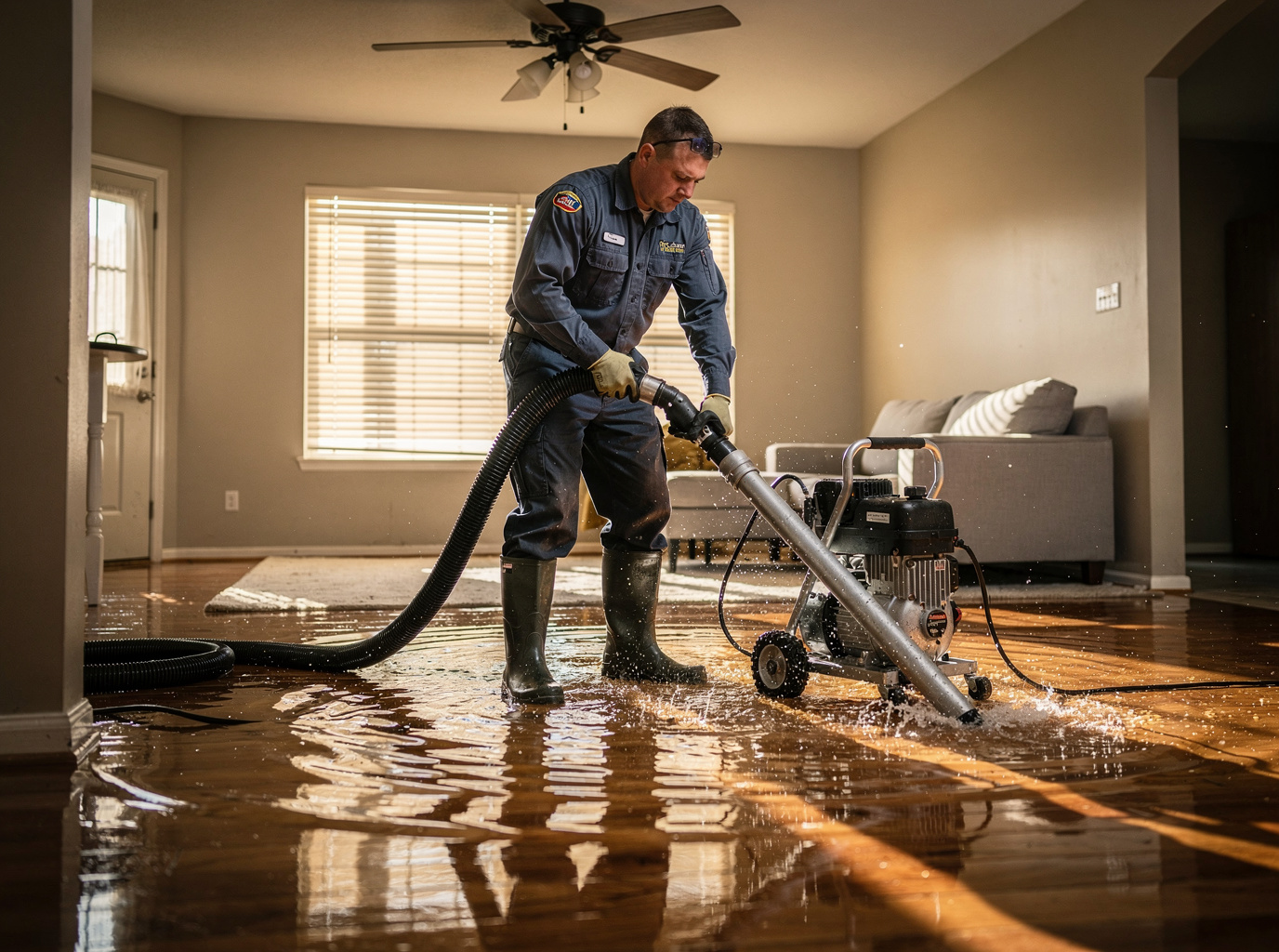
Baton Rouge homes built before 1970 in Spanish Town and the Garden District often have pier-and-beam foundations and plaster walls that trap water against sills and behind baseboards. Emergency water removal crews must pull carpet, padding, and affected drywall within hours because the humid subtropical climate keeps indoor relative humidity above 70 percent even in mild winters. Failure to reach hidden pockets near the Louisiana State Capitol area or LSU Campus crawl spaces allows capillary wicking into framing lumber within 24 hours.
Sump pump failures after heavy rain on the flat terrain of Old South and Downtown properties send groundwater through slab cracks and into finished basements. Technicians use truck-mounted extractors rated for 200-plus gallons per minute followed by air movers angled at 45 degrees to force evaporation from joist bays. Older cast-iron drain lines common in Mid City frequently crack under pressure, so crews camera the lines before declaring the structure dry.
After extraction, crews document moisture readings with penetrating meters on every affected wall in East Baton Rouge Parish homes. This data determines whether lath-and-plaster must be removed or whether dehumidifiers alone can pull residual moisture from brick nogging. Work near the Baton Rouge River Center or close to New Orleans-bound traffic corridors often requires traffic control permits when equipment is staged on the street.
Technician insight
In Baton Rouge the thing that catches most people out with Emergency Water Removal is how quickly moisture travels under the wide plank floors of 1920s Garden District homes; once it reaches the joist pockets the humidity here keeps it wet for weeks if you only pull the carpet.
Mid City slab leak after hours
A washing machine supply line burst in a 1960s Mid City home while the owners were at work near the LSU Campus. Water migrated under the slab and wicked into the living room drywall. Crews extracted 180 gallons, removed 22 feet of baseboard and carpet, then ran drying equipment for four days until meter readings dropped below 12 percent.
Emergency Water Removal Services We Offer
✓Crawl Space Water Extraction
Removes standing water from pier-and-beam homes in Spanish Town and Garden District where high water tables push moisture under sills.
✓Slab Leak Water Removal
Extracts water that has migrated under concrete slabs common in Mid City and Old South after supply line or sewer failures.
✓Carpet and Pad Extraction
Pulls saturated carpet and padding before mold colonizes backing in humid East Baton Rouge Parish interiors.
✓Appliance Flood Extraction
Rapid removal of water from washing machine, water heater, or dishwasher leaks before it reaches LSU Campus rental properties.
✓Storm and Roof Leak Extraction
Handles wind-driven rain entry through older roofs in Downtown and near the Louisiana State Capitol.
✓Sump Pump Failure Response
Emergency pumping and drying after power loss or pump breakdown during heavy East Baton Rouge Parish rains.
Emergency Water Removal Cost in Baton Rouge, LA
| Service | Typical Range | What Affects It |
|---|---|---|
| Single-room extraction | $350–$650 | Increases with slab or pier-and-beam access in older Mid City homes. |
| Whole-house extraction | $900–$1,800 | Higher when multiple levels or finished basements are involved. |
| Crawl space extraction | $450–$850 | Depends on standing water depth and debris load. |
| Appliance leak extraction | $250–$450 | Lower when limited to one room and no subfloor damage. |
Ranges are typical for Baton Rouge, LA and confirmed with an exact written quote before any work starts.
How it works
- 1
Site Assessment
Technicians arrive, locate the water source, and map affected rooms using moisture meters while noting foundation type and neighborhood.
- 2
Water Extraction
Truck-mounted and portable pumps remove standing water from floors, crawl spaces, and wall cavities before humidity rises further.
- 3
Material Removal
Saturated carpet, pad, and baseboards are cut and bagged to prevent cross-contamination in older Baton Rouge homes.
- 4
Initial Drying Setup
Air movers and dehumidifiers are positioned to begin evaporation while crews document readings for insurance.
- 5
Final Moisture Verification
Daily meter checks continue until drywall and framing reach acceptable dry standards for the local climate.
Pricing
Cost depends on water volume, access to crawl spaces or slabs, and how many rooms require material removal.