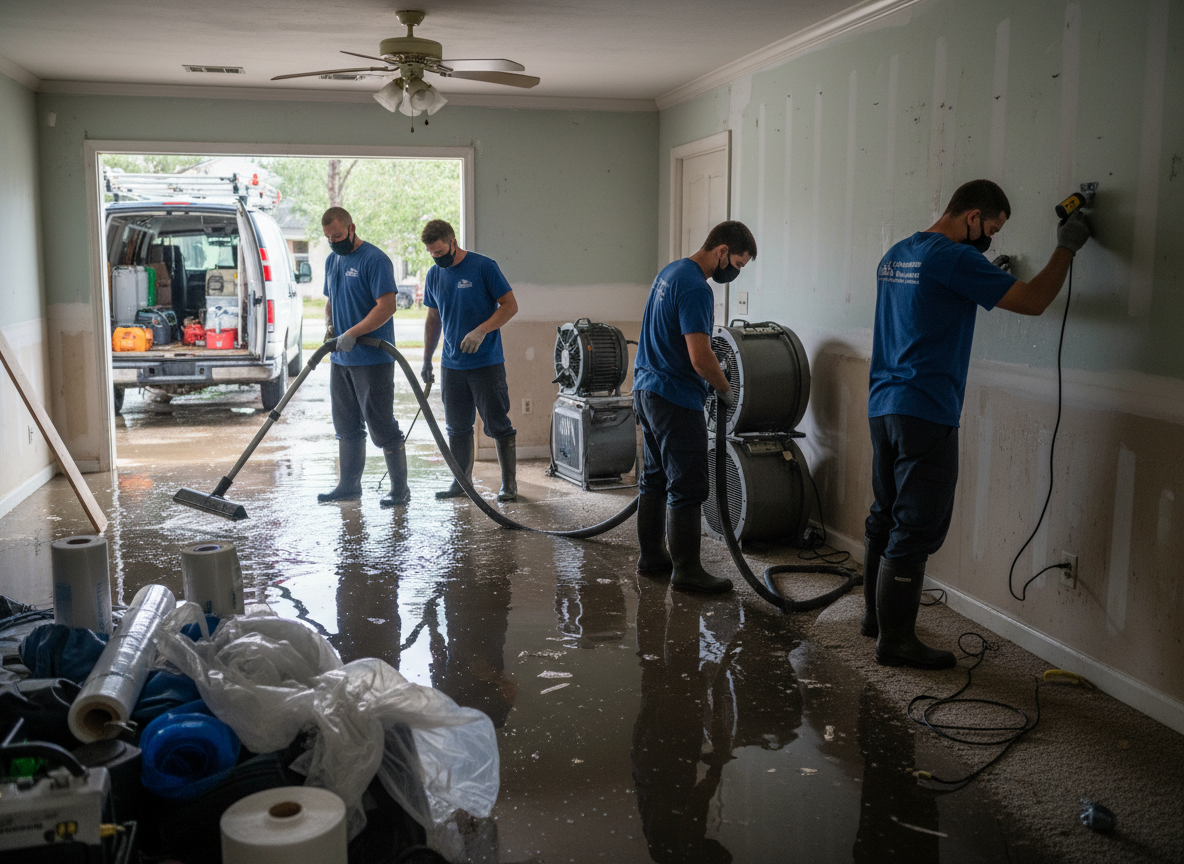
Baton Rouge sits in a humid subtropical climate where summer heat and frequent heavy rains push moisture deep into older homes. Properties in Mid City and Spanish Town often feature raised foundations and pier-and-beam construction from the early 1900s, so water that reaches the crawlspace can wick upward into floor joists within hours. Technicians must pull baseboards and drill weep holes to allow airflow, or hidden mold colonies form before the job is finished.
East Baton Rouge Parish soil is heavy clay that holds water against slab edges, especially in Garden District and Old South neighborhoods. When a supply line bursts under a 1960s slab home near the Louisiana State Capitol, water travels laterally under the concrete and resurfaces in adjacent rooms. Extraction crews use moisture meters mapped room-by-room and often have to remove sections of hardwood to reach saturated subfloors before drying can begin.
Downtown high-rises and LSU Campus apartments add another layer: shared walls and limited access points mean water from a roof leak at the Baton Rouge River Center can migrate two floors down before anyone notices. Restoration teams coordinate with property managers to isolate HVAC zones so dehumidifiers do not spread spores through the building. Work is scheduled around class times or event load-ins to keep disruption low.
Nearby cities such as New Orleans and Lafayette see similar storm patterns, yet Baton Rouge jobs differ because of the mix of historic wood-frame and post-1970s slab construction packed into a smaller parish footprint. Crews keep extra desiccant units on hand during hurricane season because power outages can stretch drying times from three days to a week when generators are unavailable.
Technician insight
In Baton Rouge, the thing that catches most people out with Emergency Water Damage Restoration is how fast the humid subtropical air turns a small leak into widespread mold under pier-and-beam floors in Spanish Town and Mid City homes; once moisture hits the clay soil around the foundation, drying times double if crews do not pull baseboards on day one.
Mid City Bungalow Pipe Burst
A supply line failed overnight in a 1920s raised home near Spanish Town, sending water into the crawlspace and up through oak floors. Extraction crews removed baseboards, drilled weep holes, and ran desiccant dehumidifiers for four days to counter the parish humidity. The structure dried completely and the owners moved back in without mold issues.
Emergency Water Damage Restoration Services We Offer
✓Burst Pipe Emergency Extraction
Immediate water removal and moisture mapping after supply-line failures common in Mid City and Spanish Town homes.
✓Flooded Crawlspace Drying
Targeted extraction and dehumidification under pier-and-beam houses where clay soil traps water against foundations.
✓Sewage Backup Remediation
Containment, removal, and disinfection after municipal line backups that affect older neighborhoods near Downtown.
✓Roof Leak Water Removal
Ceiling and attic drying after heavy rain penetration, especially around LSU Campus and Garden District structures.
✓Slab Leak Containment
Core drilling and perimeter drying for water that travels under concrete in Old South and East Baton Rouge Parish homes.
Emergency Water Damage Restoration Cost in Baton Rouge, LA
| Service | Typical Range | What Affects It |
|---|---|---|
| Initial Assessment | $150–$300 | Varies by property size in Garden District or Mid City |
| Water Extraction | $600–$1,800 | Higher when crawlspace access is limited in older East Baton Rouge Parish homes |
| Drying Equipment Rental | $400–$1,200 | Per week; increases during humid summer months |
| Slab Leak Containment | $900–$2,500 | Depends on core drilling and subfloor removal needed |
Ranges are typical for Baton Rouge, LA and confirmed with an exact written quote before any work starts.
How it works
- 1
On-Site Assessment
Technician arrives with moisture meters and thermal cameras to map water migration through local housing types.
- 2
Water Extraction
Truck-mounted and portable pumps remove standing water from crawlspaces, slabs, and finished floors.
- 3
Drying and Monitoring
Air movers and dehumidifiers run while daily readings track progress in humid Baton Rouge conditions.
- 4
Final Restoration
Replace removed materials and apply antimicrobial treatments where needed before returning the home to use.
Pricing
Upfront quotes provided during Mon–Fri 8am–6pm and Sat 9am–2pm; final cost depends on water volume and access.